
Scala News in Rome
7 Jul 2026
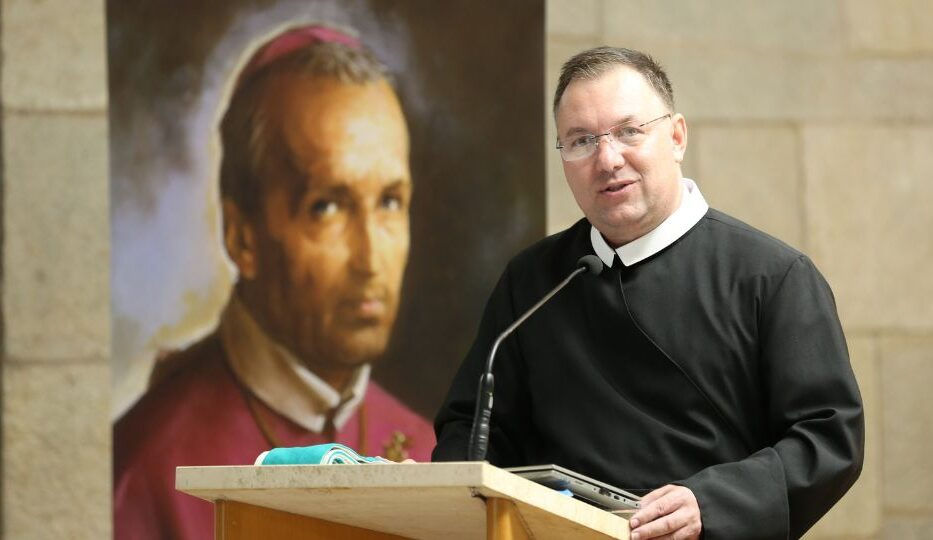
The Superior General of the Congregation of the Most Holy Redeemer (The Redemptorists), Fr. Rogerio Gomes, C.Ss.R., has issued a note to clarify that the Congregation is not connected in any way, shape, or form, to the Sons of the Most Holy Redeemer (Transalpine Redemptorists), a traditionalist Religious congregation based in Scotland.
In recent days, following the schismatic act of 1 July 2026 carried out by the Society of Saint Pius X, also known as the Lefebvrian movement, various false (fake news), inaccurate, and historically uninformed reports have circulated through social media and other means of communication. In some cases, these reports have created confusion by improperly associating the Congregation of the Most Holy Redeemer (C.Ss.R.) with groups that do not belong to its canonical structure.
For this reason, the Congregation of the Most Holy Redeemer considers it appropriate to offer the following clarifications:
The expression “Transalpine Redemptorists” originally has a historical meaning. Between the end of the eighteenth century and the beginning of the nineteenth century, Saint Clement Mary Hofbauer brought the Congregation founded by Saint Alphonsus Maria de Liguori beyond the Alps, promoting its expansion throughout Central Europe. For this reason, the Redemptorists established in those regions became known as “Transalpine.” Saint Clement remained always faithful to the Congregation and to the Church and was canonized by Pope Pius X on 20 May 1909, in recognition of his heroic virtues and his extraordinary contribution to the expansion and mission of the Congregation of the Most Holy Redeemer.
The community now known as the “Transalpine Redemptorists” originated in 1988 as a group separated from the Congregation of the Most Holy Redeemer, initially linked to the traditionalist movement associated with the Society of Saint Pius X. It later adopted the name “Sons of the Most Holy Redeemer” (F.SS.R., Filii Sanctissimi Redemptoris).
In 2008, this community was reconciled with the Holy See, and on 15 August 2012 it was erected as a clerical religious institute of diocesan right in the Diocese of Aberdeen, Scotland. However, it has never been part of the Congregation of the Most Holy Redeemer (C.Ss.R.), nor has it ever been juridically affiliated with the Redemptorist General Government.
In recent years, new doctrinal and ecclesial tensions have emerged involving the Filii Sanctissimi Redemptoris, especially because of statements critical of the Second Vatican Council, the Popes who followed the Council, and various aspects of the life of the contemporary Church. Such positions do not represent the Congregation of the Most Holy Redeemer and are monitored and evaluated by the competent ecclesiastical authorities.
It is also necessary to clarify that the Redemptorists present in Scotland who belong to the Congregation of the Most Holy Redeemer are not schismatics. The Redemptorist communities in that country belong to the London Province and remain in full communion with the universal Church, the Roman Pontiff, and the General Government of the Congregation. Their members profess the same faith as the Church, embrace the authentic Magisterium, recognize the authority of the Second Vatican Council, and carry out their mission in accordance with the Constitutions and Statutes of the Congregation, as well as with the law of the Church.
The Congregation of the Most Holy Redeemer, founded by Saint Alphonsus Maria de Liguori in Scala, in the Kingdom of Naples, on 9 November 1732, has remained and continues to remain firmly united to the Apostolic See and the Successor of Peter. In fidelity to the renewal promoted by the Second Vatican Council, between 1967 and 1969 the Congregation initiated a process of revision and updating of its Constitutions and Statutes. The revised text was approved by the Sacred Congregation for Religious and Secular Institutes on 2 February 1982, the Feast of the Presentation of the Lord, by a decree signed by His Eminence Cardinal Eduardo Pironio, Prefect, and Archbishop Agostino Mayer, O.S.B., Secretary (cf. Prot. No. R57-1/79). The Constitutions and Statutes were subsequently promulgated for the entire Congregation by the Superior General, Fr. Joseph G. Pfab, C.Ss.R., on 25 February 1982. Subsequently, the General Chapter of 1985 introduced certain adaptations in light of the new Code of Canon Law and the conciliar decree Perfectae Caritatis (nos. 2-4) concerning the renewal of religious life. The updated text was again submitted to the Sacred Congregation for Religious and Secular Institutes and, after due examination, received approval and confirmation on 23 July 1986. The corresponding decree was signed by Archbishop Vincenzo Fagiolo, Secretary, and Fr. Jesús Torres, C.M.F., Undersecretary.
Throughout nearly three centuries of history, the Congregation has offered the Church a fruitful witness of holiness and ecclesial fidelity. Among its members are saints such as Saint Alphonsus Maria de Liguori, Saint Clement Mary Hofbauer, Saint Gerard Majella, and Saint John Neumann, as well as Blessed Gaspar Stanggassinger, together with numerous blesseds, martyrs, venerables, and servants of God who have borne witness to the Gospel and to ecclesial communion in different times and circumstances.
It is necessary to distinguish clearly between the Congregation of the Most Holy Redeemer (C.Ss.R.), composed of Redemptorist missionaries, priests, and brothers present in more than eighty countries, and the community known as the “Transalpine Redemptorists” or “Sons of the Most Holy Redeemer” (F.SS.R.), which constitutes a distinct juridical reality and does not belong to the Congregation founded by Saint Alphonsus.
It is regrettable that a lack of historical and canonical knowledge, combined with the rapid spread of information through social media, has contributed to confusion among the faithful. For this reason, we urge everyone to verify sources carefully and to avoid disseminating inaccurate content that may harm historical truth, ecclesial communion, the identity of the Redemptorist mission, and the witness of unity that the Church is called to offer to the world.
The Congregation of the Most Holy Redeemer reaffirms its full communion with the Catholic Church, the Roman Pontiff, and the Magisterium of the Church. It likewise reaffirms its adherence to the teachings of the Second Vatican Council, which continue to illuminate and guide its religious life, spirituality, evangelizing mission, and service to the poorest and most abandoned.
Faithful to the heritage of Saint Alphonsus Maria de Liguori and to the witness of so many Redemptorist saints, blesseds, martyrs, and missionaries throughout history, we remain committed to proclaiming the Abundant Redemption, promoting ecclesial communion, and generously serving the People of God.
May Our Mother of Perpetual Help continue to accompany the Congregation of the Most Holy Redeemer in its mission of proclaiming the Abundant Redemption to the poorest and most abandoned.
Fr. Rogério Gomes, C.Ss.R.
Superior General